


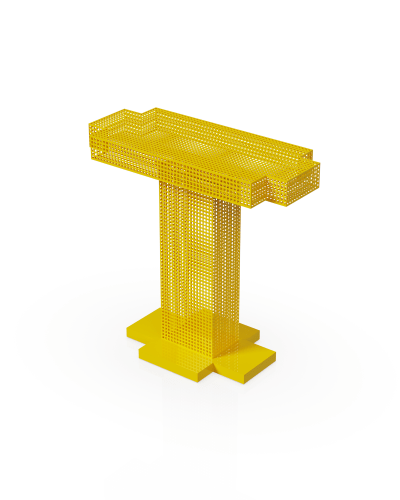
On the invisible roots of creation

Before an object exists, it lives as a thought — vague, weightless, unfinished.
Somewhere between the hand and the mind, between intuition and form, imagination begins to take shape.
Bruno Munari once wrote that fantasy, invention, creativity, and imagination are not the same thing. Fantasy dreams without limits. Invention finds solutions. Creativity connects what seems unrelated. Imagination, however, gives form to the invisible. It is the bridge between what we know and what we can only sense.
In design, imagination is often treated as something spontaneous, even accidental — a spark that happens in a moment of inspiration. But in truth, it is a discipline. It requires patience, attention, and the ability to see possibilities where others see boundaries.
Every constraint — material, proportion, process — becomes a tool for invention.
Metal resists, wood cracks, time runs out. These limits force us to think differently. They sharpen the mind. They give birth to new gestures.

We live in a world that celebrates novelty. We are surrounded by endless versions of the same idea, polished until they lose their soul. But new shapes are not the same as new thoughts. To truly invent, we must learn to imagine again — not faster, but deeper.
Imagination is also a material.
It bends, stretches, transforms. It leaves fingerprints on everything we make. Like steel or clay, it remembers the movement of the hand.
For me, the act of making begins in silence — before the tool touches the surface, before the first mark appears. It is a moment of uncertainty, when the form is still liquid, undefined. That moment is where imagination lives.

Design, at its core, is an exercise in seeing.
It is not an escape from reality, but a way to enter it more consciously — to reimagine what already exists, to find meaning in matter.
Because to imagine is to care.
And every act of imagination is, in its own way, a gesture of hope.

by Bruno Munari (Contributor), Jeffrey Schnapp (Translator)